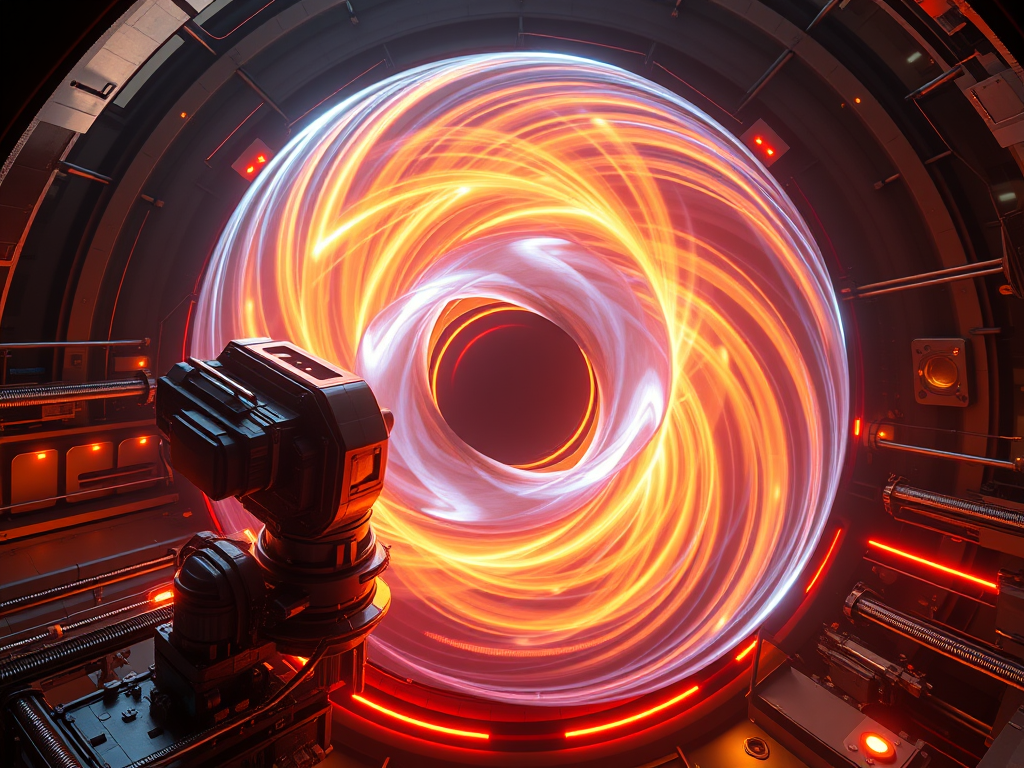
Fusion reactors promise clean energy but face complex engineering challenges. The main issue involves controlling plasma that reaches millions of degrees. Magnetic fields confine plasma inside a doughnut-shaped chamber called a tokamak. If the plasma touches the walls, it can damage the reactor and halt reactions. Engineers search for ways to protect reactor components from extreme heat. In my opinion, this protection is vital for sustainable fusion.
Researchers from Princeton University and MIT developed an AI tool called HEAT-ML. The tool quickly calculates safe zones where magnetic field lines shadow sensitive components. In a tokamak, some magnetic field lines connect the plasma to the reactor wall. These connections concentrate heat on small areas. Traditionally, physicists use complex simulations to trace these lines. Each simulation can take minutes to hours on high-performance computers. HEAT-ML uses a neural network to approximate these calculations. The network trains on data generated by the original code called HEAT.
After training, HEAT-ML can predict magnetic shadow regions in milliseconds. This speed allows engineers to explore many reactor designs quickly. In my view, AI provides a powerful shortcut without sacrificing accuracy. HEAT-ML focuses on the SPARC tokamak under construction by Commonwealth Fusion Systems. SPARC aims to demonstrate net energy gain by using strong magnets and compact size. The AI model includes data from about a thousand magnetic configurations. It predicts where high-energy particles will hit the reactor surfaces. This helps designers position shielding and cooling channels. It also informs operational strategies to reduce heat flux. I appreciate how the team validated the AI predictions against detailed simulations.
The agreement shows that surrogate models can be reliable. They also plan to expand the training data to include other tokamak geometries. This could generalize the model to different reactors like ITER. In my opinion, flexibility is key for such tools. Fusion devices vary widely in size, magnet strength, and wall materials. A generalized AI tool could accelerate innovation across the field. Beyond design, HEAT-ML might assist with real-time control during experiments. Operators could adjust magnetic coils to steer heat loads away from vulnerable components.
Quick predictions would enable adaptive control strategies. This integration of AI into plasma control exemplifies the future of fusion research. It combines physics knowledge with machine learning. I think this synergy fosters innovation and reduces costs. However, there are challenges to consider. Training data generation requires expensive simulations. If the operational conditions exceed the training range, predictions may be unreliable. Researchers must monitor the model’s limitations and update it with new data. Another concern involves interpretability.
Neural networks can appear like black boxes. Engineers must trust the tool’s outputs to make design decisions. Explainable AI techniques could shed light on why certain magnetic configurations produce specific heat patterns. Transparency will increase confidence in the tool. I also wonder about integration with other aspects of reactor design. Safe zone calculations interact with structural stresses, material endurance, and coolant flow. Coupling HEAT-ML with models for these domains could provide holistic optimization. In my view, interdisciplinary collaboration is essential. The project demonstrates the benefits of partnerships between academia and industry.
MIT’s private fusion startup contributed resources and real-world constraints. Princeton University offered expertise in plasma physics and machine learning. Collaboration ensures that the tool addresses practical needs while pushing scientific boundaries. Public funding agencies supported the research through energy and fusion initiatives. This underscores the importance of government investment in basic science. I hope policymakers continue to fund such high-impact projects.
The success of HEAT-ML could influence energy policy and public perception of fusion. Achieving net energy gain in SPARC would energize the field. It might attract more students to study plasma physics and computing. In my opinion, inspiring the next generation of scientists is crucial. The research also shows how AI can accelerate progress in other scientific domains. Surrogate models reduce computational burden and enable rapid exploration. Similar approaches could optimize battery materials, aerodynamic designs, or drug discovery.
I like the idea of combining physics-based simulations with machine learning. This hybrid approach leverages strengths of both methods. As society faces climate change, we need efficient tools to develop sustainable technologies. HEAT-ML is one step toward that goal. Some critics worry that AI may replace human expertise. I believe the opposite. AI acts as an assistant that amplifies human creativity. Physicists still define training datasets, interpret results, and set research directions.
The tool frees time for deeper thinking and innovation. In conclusion, AI tools like HEAT-ML represent a promising direction for fusion energy. They accelerate design, enable real-time control, and foster collaboration. In my opinion, they also highlight the synergy between data science and physics. I recommend reading the original article for more technical details and updates. Exter
I would like to add more reflections. Fusion energy remains one of humanity’s grand challenges. It requires international cooperation and sustained investment. AI tools can help but cannot replace fundamental experimental research. Engineers must continue building and testing prototype reactors. HEAT-ML reduces computational load but field work still matters. I hope future tools integrate additional physics, like turbulence and particle-wall interactions. This will enhance reliability of predictions. Another area involves engaging the public. Clear communication about fusion technology fosters support and reduces misinformation. In my opinion, transparency in research builds trust. Opening datasets and publishing open-source code invites collaboration.
Students, engineers, and enthusiasts can contribute ideas. I encourage educators to integrate fusion and AI topics into curricula. This cross-disciplinary training will prepare the next generation of innovators. With climate change accelerating, we urgently need sustainable energy sources. Fusion holds promise but success is not guaranteed. Projects like HEAT-ML represent progress on the long road ahead. I remain hopeful that continued collaboration, innovation, and public support will deliver fusion power. Until then, we should pursue all clean energy avenues including solar, wind, and geothermal. In conclusion, HEAT-ML shows how AI can accelerate complex engineering endeavors. It underscores the importance of open science, interdisciplinary cooperation, and perseverance. My opinion remains optimistic but grounded in reality. The path to fusion energy will require patience and curiosity. Let’s stay engaged and support researchers pushing the boundaries of knowledge.

Leave a Reply