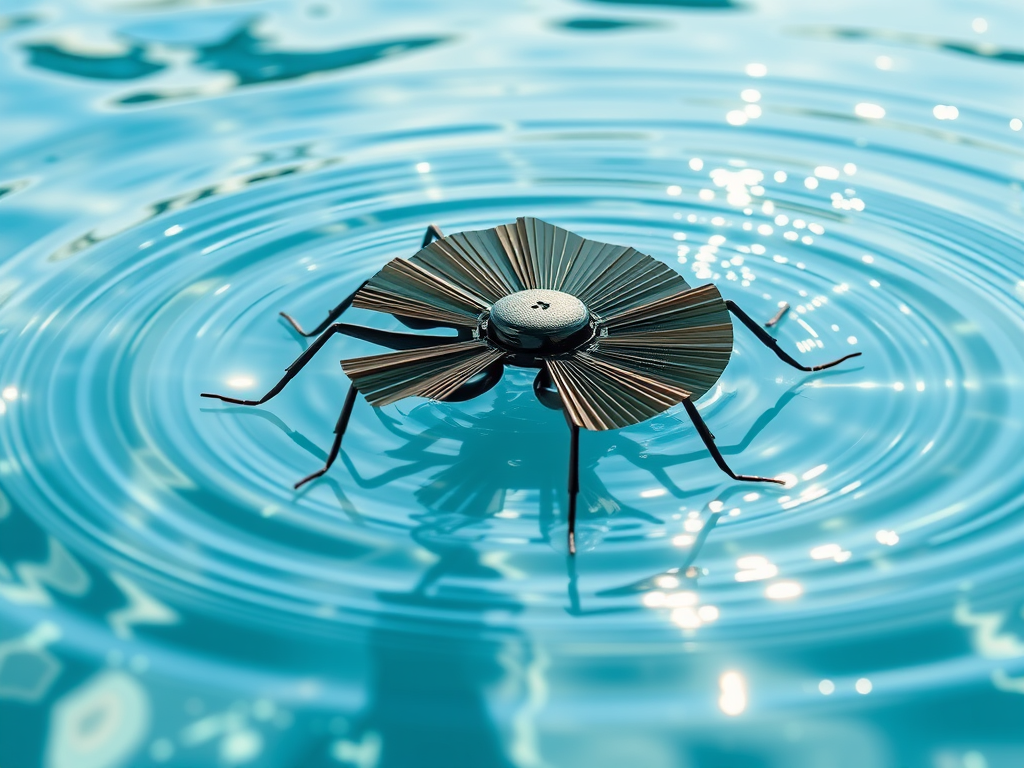
A new insect-scale robot called the Rhagobot glides across water by deploying fan-like legs inspired by ripple bugs. This design uses passive morphing to move quickly and precisely without extra energy.
Researchers at the University of California, Berkeley, Georgia Tech, and Ajou University studied Rhagovelia water striders, small semiaquatic insects known for their agility in turbulent streams. They discovered that the insects’ flat, ribbon-like fans open and close passively under the influence of water surface tension and elastic forces, rather than muscular power.
These fans expand instantly when they touch water and collapse when withdrawn, acting like tiny oars. The mechanism allows the bugs to execute sharp turns in just fifty milliseconds and travel at speeds up to one hundred twenty body lengths per second.
Lead researcher Victor Ortega-Jimenez observed ripple bugs during his postdoctoral work and became fascinated by their rapid movements. He teamed up with other scientists to unravel the biomechanical secrets behind the fans.
Previously researchers assumed the fans were powered by muscles. However, experiments showed that surface tension and the elastic properties of the fan material drive the passive morphing process.
Understanding the fan’s microstructure was critical. Dongjin Kim and Je-Sung Koh from Ajou University used scanning electron microscopy to capture high-resolution images of the fans. They discovered that the natural fans have a flat-ribbon morphology that provides both flexibility and stiffness.
Using these insights, engineers designed a synthetic elastocapillary fan weighing only one milligram. The fan deploys itself when it contacts water and collapses as it leaves the surface. This mechanical intelligence is built into the shape and materials rather than requiring electronics or motors.
The team built a tiny robot, called the Rhagobot, that incorporates the self-morphing fans. Tests showed that the robot achieves enhanced thrust, braking, and maneuverability compared with earlier microrobots. It can speed across water surfaces and execute rapid turns like its biological inspiration.
Because the fans rely on water surface forces, the robot uses much less energy than conventional designs. This efficiency is crucial for small-scale robotics where power supplies are limited.
The researchers emphasize that collaboration across disciplines was essential. The project combined experimental biology, fluid mechanics, materials science, and engineering design. Saad Bhamla at Georgia Tech and other team members worked together for more than five years to decode the ripple bug’s secrets.
Their findings could inform the design of future microrobots that can explore rivers, streams, and other aquatic environments. Such robots could monitor water quality, study ecosystems, or assist search-and-rescue missions in conditions where larger robots cannot operate.
The Rhagobot also demonstrates a broader principle: passive mechanisms inspired by nature can outperform active systems. By letting materials and geometry do the work, engineers can reduce complexity, weight, and power consumption.
Future research may explore using different materials or fan shapes to enhance performance or enable robots to switch between land and water. The team also plans to study how multiple fans interact with complex flows and how to control robots in groups.
By understanding and harnessing the mechanics of tiny insects, researchers open new horizons for bio-inspired engineering. The ripple bug’s design highlights how evolution solves problems elegantly, and it encourages engineers to look beyond conventional technologies.
The work underscores that scientific progress often emerges from interdisciplinary collaboration. When experts in biology, physics, and engineering share insights, they can unlock innovations that no single field could achieve alone.
As microrobots become more capable, they may play roles in medicine, environmental monitoring, and micro-manufacturing. Designs like the Rhagobot show that even the smallest creatures can inspire big engineering breakthroughs.
This research adds to a growing body of work on bio-inspired robotics. From flapping-wing drones to climbing gecko robots, engineers continue to draw lessons from nature. The Rhagobot’s fans provide a new tool in the quest for agile, efficient, and resilient machines.
References: ScienceDaily article “Scientists unlock nature’s secret to superfast mini robots,” August 24, 2025.

Leave a Reply